
Can Adjustable Beds Fit in Bed Frame: Quick Guide
Most adjustable bases fit inside standard frames if internal rail clearance allows. Verify dimensions and weight limits before purchase for November 2026.
 By Kate McGregor
Updated October 28, 2026

Most motorized adjustable bases will fit inside a standard bed frame, provided the internal rail dimensions and floor clearance accommodate the base’s height and articulation range. This compatibility depends heavily on the specific frame design, such as whether it uses a solid platform deck or open slats, and the total height of the base unit. Buyers often face friction when attempting to drop a zero-clearance base into a decorative frame that lacks sufficient internal width or depth.
The core issue is ensuring the base can lift to its maximum angle without binding against the side rails or footboard. Verifying these measurements before assembly is critical to avoiding costly returns or structural damage to the bedroom furniture. This guide outlines the precise dimensional checks and mechanical considerations required to ensure a seamless fit for can adjustable beds fit in bed frame setups, focusing on clearance, weight distribution, and articulation mechanics.
The distinction between a standalone adjustable bed and a base that drops into an existing frame is a common point of confusion for shoppers. A standalone unit includes its own upholstery and structural rails, while a drop-in base is a motorized foundation designed to replace a box spring or slat system inside a pre-owned or newly purchased frame. The latter requires careful attention to the internal pocket dimensions of the host frame. If the frame is too narrow, the base may not slide in, or the mattress may shift during operation.
Conversely, if the frame is too tall, the bed height may become ergonomically uncomfortable for sitting or standing. Understanding these spatial relationships helps buyers avoid the frustration of unboxing a motorized base only to find it incompatible with their chosen headboard or side rails. This analysis covers the key structural and dimensional factors that determine whether a specific base will function correctly within a standard bed structure.
| Award | Product | FCH Score About FCH ScoreThe FCH Score is our own rating from 0 to 10, based on performance, design and build, ease of use, and value. It reflects independent research and is never influenced by manufacturers, retailers, or affiliate commissions. Learn more › | |
|---|---|---|---|
| Best Overall |
 Allewie Queen Upholstered Panel Bed Frame |
9.2/10 | Buy |
| Best Premium |
 Best Choice Products Queen Adjustable Bed Frame |
9.1/10 | Buy |
| Best Value |
 Marsail Queen Electric Adjustable Bed Base |
8.9/10 | Buy |
 Boyd Sleep Adjusta Flex Queen Bed Base |
8.6/10 | Buy | |
 DUMOS Full Adjustable Bed Frame |
8.1/10 | Buy | |
| Best Budget |
 Awesofurni 7-Inch Queen Metal Bed Frame Base |
8.0/10 | Buy |
 FLEXISPOT Queen Upholstered Adjustable Bed |
8.0/10 | Buy | |
 Blissful Nights z4 Queen Zero-Clearance Adjustable |
7.8/10 | Buy |
Allewie Queen Upholstered Panel Bed Frame
Featuring a tailored square-stitched headboard with three height settings, this Queen panel bed delivers a clean, classic look for the bedroom. Its mixed wood and metal frame can be assembled by one person in roughly half an hour, though it requires a separate box spring setup.
Pros
- Three-level adjustable headboard fits various mattress profiles
- Quick 30-minute assembly by one person
- All parts and tools packed inside headboard
- Durable wood and metal construction with galvanized hardware
Cons
- Requires a box spring to support the mattress
- Mattress and box spring are not included
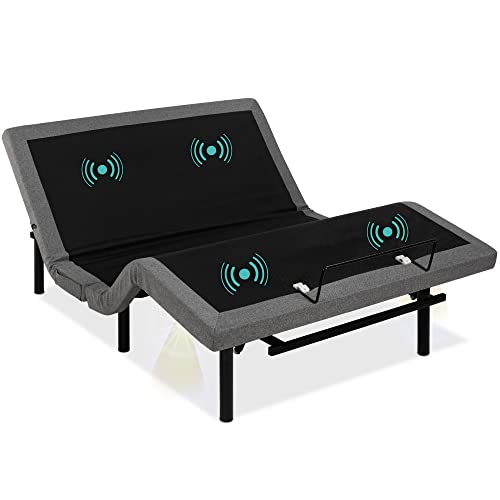
Best Choice Products Queen Adjustable Bed Frame
The Best Choice Products Queen Ergonomic Adjustable Bed Frame provides independent head and foot articulation with a 750-pound weight capacity and built-in massage features. Designed to replace traditional foundations for compatible foam and hybrid mattresses, it suits shoppers seeking customized sleep angles and integrated bedside utilities.
Pros
- Independent head and foot incline with convenient presets including Zero Gravity and TV mode
- Robust 750-pound manufacturer weight capacity to support sleepers and heavier hybrid or foam mattresses
- Integrated bedside conveniences including dual USB charging ports, side storage pocket, and under-bed nightlights
- Wireless remote control with built-in flashlight and three distinct massage vibration settings (wave, pulse, constant)
- Eliminates the need for a traditional box spring across compatible foam, latex, and hybrid mattresses
Cons
- Substantial unit weight of 137 pounds makes stairwell navigation and bedroom positioning difficult for a single person
- Incompatible with traditional rigid innerspring mattresses that cannot bend during independent head or foot articulation
- Fixed overall height of 14.25 inches offers no documented multi-stage leg height adjustments for lower platform clearances
Marsail Queen Electric Adjustable Bed Base
Built with independent head and foot articulation and a 750-pound weight capacity, this motorized Queen base caters well to sleepers seeking customized ergonomic positions. Integrated USB ports, under-bed LED lighting, and quiet dual motors make it a functional upgrade for compatible foam or hybrid mattresses.
Pros
- Generous 750-pound weight capacity accommodates most sleepers
- Dual USB-A and USB-C ports provide convenient charging
- Under-bed LED lighting aids nighttime visibility
- Quiet dual motors adjust head and foot independently
Cons
- Heavy 116-pound frame is difficult to move alone
- Requires nearby wall outlets to power base functions
Boyd Sleep Adjusta Flex Queen Bed Base
Designed to drop directly onto existing slats or platform frames, this motorized insert adds a 3 to 60-degree head incline without replacing your bedroom furniture. The wireless remote and quiet motor make it an accessible upgrade for managing acid reflux or reading comfortably.
Pros
- Smooth head incline from 3 to 60 degrees
- Drops directly onto existing bed slats and platforms
- Quiet motorized operation with wireless remote control
- Compatible with most foam, latex, and hybrid mattresses
- Backed by a 5-year limited warranty
Cons
- Only elevates the head, without foot articulation
- Platform bed frame and headboard are not included
DUMOS Full Adjustable Bed Frame
Featuring independent head and foot articulation, this electric base brings customizable ergonomic support to standard Full mattresses. Built-in USB charging ports and tool-free setup make it a practical upgrade for reading, relaxing, or relieving nighttime pressure.
Pros
- Independent head and foot angle adjustments
- Convenient built-in USB-A and USB-C ports
- Sturdy 750-pound maximum weight capacity
- Simple tool-free assembly process
- Compatible with memory foam, latex, and hybrid mattresses
Cons
- Mattress is not included with the base
- Heavy frame at 119.3 pounds requires help to maneuver
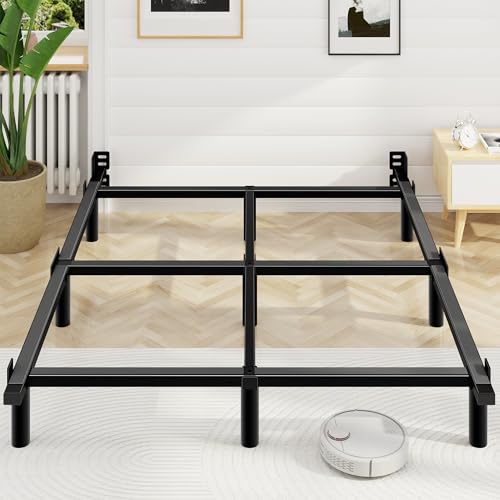
Awesofurni 7-Inch Queen Metal Bed Frame Base
The Awesofurni 7-Inch Queen Metal Bed Frame is a low-profile steel foundation built with nine reinforced legs and dual center beams specifically designed to support a traditional box spring. Featuring adjustable length settings from 75 to 81 inches and integrated noise-dampening foam, it offers a sturdy, budget-conscious base for standard and short queen setups in guest rooms and apartments.
Pros
- Nine reinforced legs and dual center beams offer balanced structural distribution across queen foundations.
- Adjustable length settings (75, 76, 80, and 81 inches) accommodate both standard queen and short queen box springs.
- Noise-reducing foam padding and anti-slip foot pads help minimize frame creaks and protect hard floors.
- Lightweight 17.5-pound steel design is easy to navigate through tight doorways and up stairwells.
Cons
- Requires a separate box spring or bunkie board foundation; cannot support a mattress directly due to the lack of close platform slats.
- Low 7-inch height provides minimal vertical clearance for tall under-bed storage bins.
- Manufacturer does not specify an exact static weight limit, necessitating careful weight distribution.
FLEXISPOT Queen Upholstered Adjustable Bed
This all-in-one bed frame seamlessly integrates an adjustable motor system with a plush velvet aesthetic, removing the need for an unsightly separate base. It is well suited for sleepers seeking ergonomic lounging without compromising bedroom style.
Pros
- Eliminates the need for a separate adjustable foundation
- Whisper-quiet motor operates smoothly under load
- Sturdy steel frame supports up to 600 pounds
- Headboard adjusts to fit four mattress heights
Cons
- Head and foot elevations adjust simultaneously rather than independently
- 600-pound weight limit must accommodate both mattress and sleepers
Blissful Nights z4 Queen Zero-Clearance Adjustable
The Blissful Nights z4 Queen is a slim 3-inch zero-clearance adjustable power foundation engineered to rest directly inside storage beds and platform frames without legs. Featuring quiet Okin motors, dual head and foot articulation, massage presets, and a 750-pound static capacity, it is an ideal upgrade for anyone seeking motorized ergonomic positioning without discarding existing bedroom furniture.
Pros
- Zero-clearance design operates without legs, making it uniquely compatible with drawer storage beds and platform foundations.
- Responsive and quiet Okin motor system paired with an impressive 750-pound static weight capacity.
- Comprehensive remote functionality with Zero G, Anti-Snore, TV Lounge, massage settings, and customizable memory presets.
- Integrated USB charging station provides convenient bedside power without extra extension cords.
- No-tools-required assembly simplifies the mechanical setup process inside the bedroom.
Cons
- Weighing between 122 and 135 pounds, navigating the package up staircases and dropping the base into a frame requires two capable adults.
- The host bed frame or platform slats must be structurally verified to support the substantial weight of the base plus the mattress and occupants.
- Requires proximity to an active AC wall outlet to power the motors, massage features, and USB charging station.

Understanding Fit: Dimensions, Clearance, and Articulation
| Frame Type | Internal Clearance Requirement | Compatibility Notes |
|---|---|---|
| Open Slat Platform | Must accommodate base height + mattress thickness | Check slat spacing for foam warranty compliance |
| Upholstered Panel Frame | Internal rail width must match base width | Verify no internal braces block motor cables |
| Traditional Box Spring Frame | Replace box spring with zero-clearance base | Ensure frame supports additional base weight |
| Storage Bed Frame | Base must fit under hydraulic lift mechanism | Confirm weight capacity includes base and mattress |
Fit is not just about width; it is a three-dimensional problem involving length, depth, and vertical height. The most critical measurement is the internal distance between the side rails of the existing frame. This dimension must be slightly larger than the width of the adjustable base to allow for easy sliding and to prevent pinching of the upholstery or mattress during articulation. If the internal width is too tight, the base may jam against the rails when the head or foot section lifts.
This can cause binding in the motor, leading to premature wear or failure. Buyers should measure the internal clear width of their frame and compare it to the external width of the base, typically listed in the product specifications. A clearance of at least half an inch on each side is generally recommended to ensure smooth operation and prevent friction against the frame’s interior surfaces.
Vertical clearance is the second major factor, requiring the total height of the adjustable base and mattress to fit within the frame’s internal height.
- The combined thickness must fit within the internal height of the frame without causing the mattress to protrude awkwardly or the base to bind against the bottom rail.
- For zero-clearance bases, this is less of an issue because they are designed to sit directly on the frame’s support structure, avoiding binding problems.
- However, for bases with legs or a thicker profile, the total stack height must be calculated to ensure the frame is not too short or too tall.
- If the frame is too short, the bed may sit too low to the floor, making it difficult to get in and out for users.
- If the frame is too tall, the bed may become uncomfortably high, especially for shorter users who need ergonomic access to the sleeping surface.
- Measuring the internal height of the frame and adding it to the base and mattress heights provides a clear picture of the final bed height.
- This ensures the ergonomic setup matches the user’s needs and the room’s proportions, preventing issues with height and accessibility for all users.
Articulation range is the third dimension to consider. When the head or foot section of the base lifts, it creates a diagonal arc that requires vertical and horizontal clearance. If the frame has a footboard or a high headboard, the lifting mechanism may collide with these components. This is particularly relevant for frames with enclosed designs or decorative elements.
The base’s maximum lift angle, often up to 60 degrees for the head and 40 degrees for the foot, determines the maximum height and width of the arc. Buyers should visualize this arc within the frame’s internal space. If the frame has internal crossbars or braces, these must not interfere with the path of the lifting mechanism. This is a common oversight that leads to operational issues after installation. Ensuring the internal space is clear of obstructions is essential for safe and smooth articulation.
Key Measurements to Verify Before Purchase
Before purchasing an adjustable base for an existing frame, buyers should take precise measurements of the frame’s internal dimensions. These measurements will determine whether the base will fit and operate correctly. The following list outlines the critical dimensions to check:
- Internal clear width between side rails
- Internal clear length from headboard to footboard
- Internal vertical height from bottom rail to top of headboard
- Distance between any internal crossbars or braces
- Weight capacity of the existing frame
- Presence of internal obstructions or decorative elements
- Compatibility of frame material with base weight
- Clearance for motor cables and remote controls
These measurements should be taken with a tape measure and recorded accurately. Comparing these figures to the base’s external dimensions and articulation range will reveal any potential fit issues. If the frame’s internal width is smaller than the base’s width, the base will not fit.
If the internal height is too low, the bed may be too short. If there are internal obstructions, the base may bind during operation. Taking the time to measure carefully can save significant hassle and expense later. This step is crucial for ensuring a successful integration of the adjustable base into the existing frame.
Weight Capacity and Structural Load Considerations
Adding an adjustable base to an existing frame increases the total load on the frame’s structure. The frame must be able to support the combined weight of the base, the mattress, and the user(s). Most standard bed frames are rated for a specific weight capacity, which typically includes the mattress and user but not an additional motorized base.
Buyers must verify that the frame’s weight capacity exceeds the total load of the new setup. If the frame is not rated for the additional weight, it may sag, wobble, or fail over time. This is particularly important for heavier users or those using thick, heavy mattresses. The frame’s center support beams and legs must be sturdy enough to handle the increased dynamic load caused by the base’s articulation.
The dynamic load from an adjustable base is different from a static load. When the base lifts, it creates shifting forces that can stress the frame’s joints and support points. A frame that holds a static load well may struggle with the dynamic forces of an articulating base. This can lead to squeaking, wobbling, or structural fatigue over time.
Buyers should look for frames with robust construction, such as solid hardwood or heavy-gauge steel, and multiple center support legs. Frames with only two or three legs may not provide adequate support for the dynamic loads of an adjustable base. Ensuring the frame is structurally sound and rated for the increased load is essential for long-term reliability and safety.
Zero-Clearance Bases vs. Legged Bases
Zero-clearance adjustable bases are designed to sit directly on the frame’s support structure without legs. This makes them ideal for dropping into existing frames, as they do not add extra height. They are also compatible with storage beds, where the base sits on the platform that lifts. Legged bases, on the other hand, have their own legs and are designed to stand on the floor.
These bases are not suitable for dropping into existing frames, as the legs would interfere with the frame’s bottom rail. Buyers must ensure they are purchasing the correct type of base for their frame. A zero-clearance base is the standard choice for existing frames, while a legged base is for standalone setups. Choosing the wrong type can lead to fit issues and operational problems.

Zero-clearance bases also offer the advantage of being easier to install and remove. They can be slid into the frame and locked in place without requiring additional hardware or adjustments. This makes them a convenient option for renters or those who plan to move frequently. Legged bases, however, may require more setup and adjustment to ensure they are level and stable.
They also take up more floor space, which can be a consideration in smaller bedrooms. For most existing frames, a zero-clearance base is the recommended choice. It provides a seamless fit and minimal disruption to the bedroom layout. Buyers should confirm the base’s clearance specifications to ensure it matches their frame’s design.
Mattress Compatibility and Retention
The mattress must be compatible with the adjustable base. Most adjustable bases are designed for flexible mattresses, such as memory foam, latex, and hybrid models. Innerspring mattresses, particularly those with rigid coil cores, may not bend smoothly with the base and can cause damage to both the mattress and the base.
Buyers should verify that their mattress is labeled as adjustable-compatible. If the mattress is not flexible, it may crack or delaminate when the base articulates. This can void the mattress warranty and compromise sleep comfort. Using a compatible mattress is essential for the longevity of both the base and the mattress.
Mattress retention is another important factor. When the base lifts, the mattress can slide or shift if it is not secured. Most adjustable bases include a retention bar or lip that holds the mattress in place. Buyers should ensure that the base’s retention mechanism is compatible with their mattress’s thickness and edge profile.
If the mattress is too thick or has a rounded edge, it may not stay in place during articulation. This can be frustrating and potentially dangerous. Some bases include adjustable retention bars that can be tightened or loosened to fit different mattress sizes. Buyers should check for this feature and ensure the base can secure their specific mattress. Proper retention ensures a stable and safe sleeping experience.
Frame Design and Articulation Interference
The design of the existing frame can impact the base’s articulation. Frames with high headboards or footboards may block the base’s lifting path. This is particularly true for frames with enclosed designs or decorative elements. Buyers should check the frame’s internal height and width to ensure there is enough clearance for the base’s maximum lift angle.
If the frame is too tall or narrow, the base may bind against the rails or headboard. This can cause noise, wear, or damage to the motor. Frames with open designs or low profiles are generally more compatible with adjustable bases. Buyers should visualize the base’s articulation arc within the frame’s internal space to identify any potential interference points.
Internal crossbars and braces are another common source of interference. Many bed frames have internal crossbars for added stability. These bars may block the base’s lifting mechanism or prevent the base from sliding into place. Buyers should inspect the frame’s internal structure for any obstructions. If there are crossbars, they may need to be removed or adjusted to accommodate the base.
This is not always possible, depending on the frame’s design. Frames without internal obstructions are ideal for adjustable bases. Buyers should choose frames with open internal structures to ensure smooth operation and avoid potential fit issues. This is a critical consideration for ensuring a successful installation.
Practical Tips for Ensuring a Seamless Fit
To ensure a seamless fit, buyers should follow a few practical tips. First, measure the frame’s internal dimensions carefully and compare them to the base’s specifications. Second, verify the frame’s weight capacity to ensure it can support the additional load. Third, check for any internal obstructions that may interfere with the base’s articulation.
Fourth, ensure the mattress is compatible with the adjustable base. Fifth, consider the frame’s design and profile to ensure it provides enough clearance for the base’s lift angle. These steps will help buyers avoid common fit issues and ensure a successful installation. Taking the time to plan and measure carefully is essential for a smooth and hassle-free experience.
If the frame is not compatible with the adjustable base, buyers may need to consider alternative options. This could include purchasing a new frame that is designed for adjustable bases, or choosing a standalone adjustable bed that includes its own frame. Some frames are specifically designed to accommodate adjustable bases, with open internal structures and reinforced support points.
These frames are ideal for buyers who want to upgrade to an adjustable base without replacing their entire bed setup. By choosing the right frame and base combination, buyers can enjoy the benefits of an adjustable bed while maintaining their preferred bedroom aesthetic and functionality.
In summary, most adjustable bases can fit inside standard bed frames, but compatibility depends on several key factors. These include internal dimensions, weight capacity, articulation clearance, and mattress compatibility. Buyers should measure their frame carefully and verify the base’s specifications before purchasing. By understanding these considerations, buyers can avoid fit issues and ensure a successful installation.
The right combination of frame and base will provide a comfortable, functional, and durable sleeping setup that meets the user’s needs and preferences. This guide provides the essential information for making an informed decision and achieving a seamless fit for can adjustable beds fit in bed frame scenarios.
For further insight into how standard dimensions affect bedroom planning, you might find our standard queen bed sizing guide useful for verifying rail spacing and internal pocket depths. Additionally, understanding the structural differences between various frame types can be clarified in our bed size and frame overview, which helps identify which structures support motorized foundations best.
About the author
Kate McGregor is a design and shopping editor with experience covering furniture, home décor, and interior trends. From sleeper sofas to dining chairs and storage solutions, her editorial work explores the details that make furnishings both attractive and practical.